✦ Learn ✦
Choosing the Right Canvas & Mesh Count
Understand mesh count, canvas size, and how to select the perfect canvas for your needlepoint project.
By Molly · July 9, 2026
Quick answer: Mesh count (stitches per inch) determines your finished piece's size and project speed: 14-count is ideal for beginners (forgiving, quick), 18-count offers a sweet middle ground with better detail, and 22-count delivers extraordinary precision but requires patience and good lighting. Choose based on your desired finish size, available time, and skill level—when in doubt, start with 14-count mono canvas.
Mesh count is one of the most important decisions in needlepoint—and it's also one of the most misunderstood. It feels technical, but it's genuinely elegant once you understand what it means and how it affects your finished piece. This guide demystifies the choice and builds your confidence.
What Mesh Count Actually Means
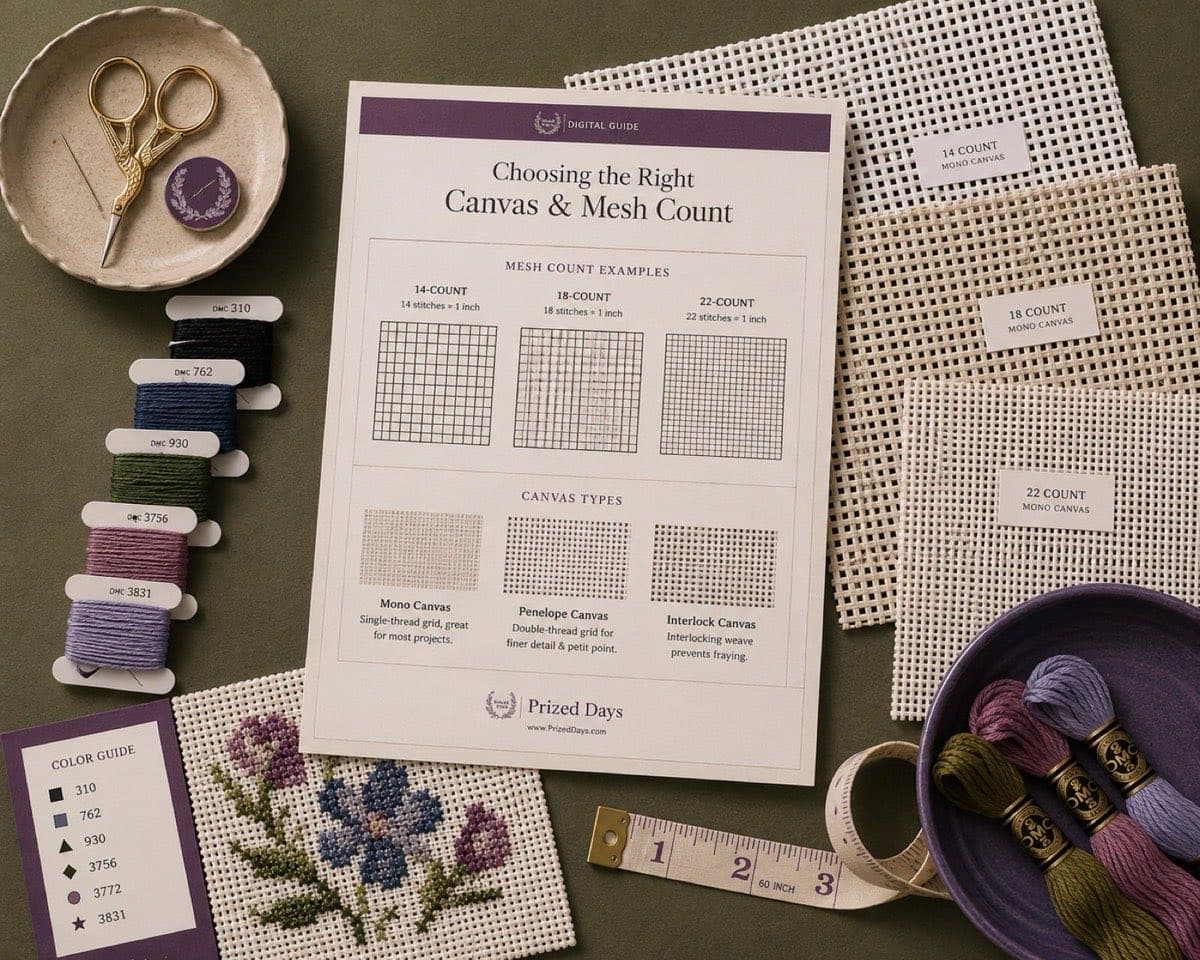
Mesh count refers to how many stitches fit into one inch of canvas. It's always written with "count"—14-count, 18-count, 22-count, etc.
- 14-count canvas = 14 stitches per inch (larger stitches, bolder appearance)
- 18-count canvas = 18 stitches per inch (medium stitches, balanced detail)
- 22-count canvas = 22 stitches per inch (fine stitches, intricate detail)
That's the entire mystery. Higher numbers mean smaller stitches; smaller numbers mean larger stitches.
The Real Impact: Finished Size
Here's what makes mesh count matter: it determines your finished piece's size.
If you have a chart that's 140 stitches wide:
- On 14-count canvas: 140 ÷ 14 = 10 inches wide
- On 18-count canvas: 140 ÷ 18 = 7.7 inches wide
- On 22-count canvas: 140 ÷ 22 = 6.3 inches wide
Same chart. Three different finished sizes. This is why understanding mesh count is crucial—it's the difference between a pillow and a small framed piece.
Choosing the Right Count for Your Project
For Beginners: Start with 14-Count
14-count canvas is the ideal starting point. Here's why:
| Factor | Why 14-Count Works |
|---|---|
| Stitch size | Large enough to see clearly without straining |
| Speed | Covers area quickly, so projects finish faster |
| Accuracy | Fewer opportunities to miscount when stitches are obvious |
| Needle size | Standard size 18 tapestry needle; widely available |
| Comfort | Less eye strain and hand fatigue during longer sessions |
| Availability | Every craft store stocks 14-count canvas |
Your first project will feel less like struggling with tiny stitches and more like the meditative experience needlepoint should be.
As You Gain Confidence: Consider 18-Count
18-count is the "sweet spot" for many needlepoint artists. It offers:
- Better stitch definition and sharper edges than 14-count
- Still manageable without magnification or excessive strain
- Slightly finer detail while remaining quick to complete
- A comfortable middle ground between speed and precision
Many intermediate projects—framed pieces, small pillows, detailed motifs—use 18-count.
For Advanced Detail Work: 22-Count and Beyond
22-count canvas (and finer) allows extraordinary detail:
- Individual stitches are tiny—perfect for photorealistic designs
- Creates an almost gallery-quality appearance when complete
- Requires patience, good lighting, and often magnification
- Best suited for artists with years of experience
Start here if you're eager, but understand you're choosing a slower, more meditative process. Some stitchers love this; others find it frustrating. There's no wrong answer—only your preference.
Canvas Types: Which One to Buy
Mono Canvas
Single-thread grid, most common, ideal for standard needlepoint.
- Best for: Beginners, most standard projects
- Appearance: Clean, visible grid
- Cost: Most affordable
- Availability: Everywhere
Start here. It's the reliable foundation.
Penelope Canvas
Double-threaded grid, allows for petit point (tiny half-stitches) within regular stitches.
- Best for: Advanced techniques, exceptional detail
- Appearance: More complex grid requiring practice to read
- Cost: Slightly higher than mono
- Availability: Specialty shops often stock it
Once you're comfortable with mono canvas, Penelope opens new creative possibilities.
Interlock Canvas
Interlocking weave prevents fraying at the edges.
- Best for: Projects without tape reinforcement
- Appearance: Similar to mono
- Cost: Slightly higher
- Availability: Specialty shops
Nice if you dislike taping; not essential for beginners.
Practical Selection Guide
Answer these questions to choose your canvas:
1. How detailed should the finished piece be?
- Impressionistic or bold designs → 14-count
- Medium detail → 18-count
- Photorealistic precision → 22-count
2. How much time do you want to invest?
- Quick project (weekend) → 14-count
- Medium project (2–4 weeks) → 18-count
- Showcase piece (months) → 22-count
3. What size do you want?
- Large (wall hanging) → 14-count (covers space faster)
- Medium (framed art, pillow) → 18-count
- Small (coaster, mini-frame) → 22-count (fine detail compensates for small size)
4. What's your current skill level?
- Complete beginner → 14-count mono
- Some experience → 18-count mono or Penelope
- Advanced → 22-count mono or Penelope
Canvas Size: How Much to Buy
When purchasing canvas, you'll see it offered in various sizes (pre-cut sheets) or by the yard. Calculate as follows:
Canvas size needed = (Chart width ÷ mesh count) + 2 inches for margins
If your chart is 140 stitches wide on 18-count:
- Working area: 140 ÷ 18 = 7.7 inches
- Plus margins: 7.7 + 2 = 9.7 inches (round up to 10 inches)
Add margins on all sides—they give you space for mounting, blocking, and framing. Skipping margins feels thrifty but creates frustration during finishing.
Color Choices: White, Ecru, or Colored Canvas
Canvas comes in neutral colors:
- White: Clean, neutral foundation for any color palette
- Ecru (natural): Slightly warm, flattering if you leave small gaps of stitching incomplete
- Colored canvas: Used strategically when chart shows through intentionally; advanced technique
Start with white or ecru. Colored canvas is a creative choice, not a necessity.
Final Thoughts
Mesh count is simply a scale. There is no universally "right" choice—only the choice that aligns with your project goals, skill level, and patience.
When in doubt, choose 14-count. You'll finish faster, build confidence, and be inspired to tackle your next project with new knowledge. With each piece, you'll develop intuition about which count suits your vision.
The chart you fall in love with dictates the count; the count you choose determines the pace and character of your needlepoint journey. Make the choice knowingly, and you've already succeeded before the first stitch.