✦ Learn ✦
How to Read a Needlepoint Chart
Master the basics of reading needlepoint chart symbols and grids with this beginner-friendly guide.
By Molly · July 12, 2026
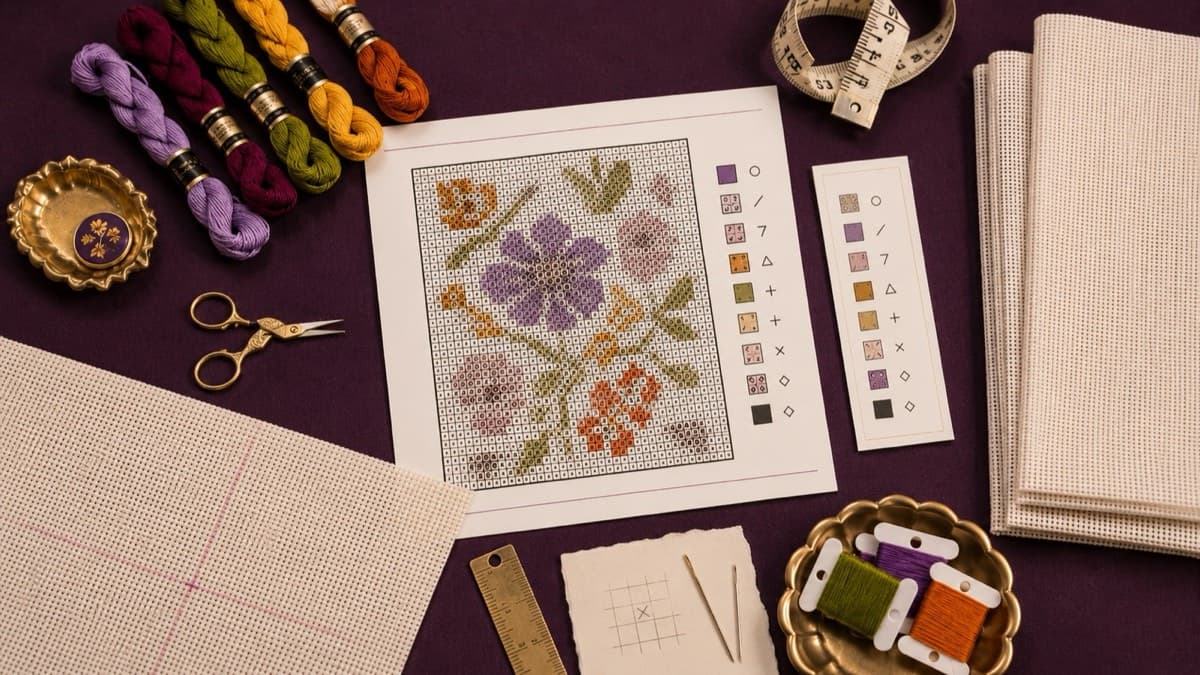
Quick answer: Each square on a needlepoint chart represents one stitch on your canvas; charts use symbols or colors matched to a legend (called a "key" or "color guide") to tell you which thread color to use at each position. Start at a center point marked on the chart, find it on your canvas, then work outward in manageable sections, counting grid lines and marking your progress with a sticky note to prevent miscounts.
Needlepoint charts are beautifully elegant once you understand their visual language. At first glance, they may seem like puzzles, but the grid system is intuitive and logical. This guide will walk you through the fundamentals so you can approach any chart with confidence.
The Grid Foundation
Every needlepoint chart is built on a simple grid. Each square in the grid represents one stitch on your canvas. The grid's size—14-count, 18-count, 22-count—tells you how many stitches fit into one inch of canvas. A 14-count chart means 14 stitches per inch; an 18-count means 18 stitches per inch, and so on.
This relationship between chart squares and canvas threads is the secret to translating your digital chart into a finished piece. One chart square = one canvas stitch.
Understanding Chart Symbols
Charts use symbols—colors, patterns, and sometimes small marks—to indicate which stitch to make at each position. Here's what you'll typically encounter:
| Symbol | Meaning |
|---|---|
| Solid color block | Full cross stitch in that color |
| Half-filled square | Half stitch (diagonal coverage) |
| Cross pattern | Backstitch outline |
| Diagonal line | Tent stitch or half stitch direction |
| Dot or small mark | French knot or specialty stitch |
Your specific chart will include a legend (often called a "key" or "color guide") that explains exactly which symbol corresponds to which thread color. Always check this legend first—it's your decoder ring.
Color Coding Made Simple
Most charts use color-coding to represent thread colors. For example, red on the chart means you're stitching with red thread; blue means blue thread. Some charts also include thread brand codes (like DMC numbers for embroidery floss) next to each color.
When printing or viewing your chart, ensure the colors print accurately. We recommend:
- Using color settings on "true color" or "best quality"
- Testing on a small scrap first if you're uncertain
- Keeping the color guide visible while you stitch
Working Grid by Grid
Here's the practical rhythm: Start at a center point on your chart (usually marked with a crosshair or arrow). Find the corresponding point on your canvas. Then work outward in manageable sections—perhaps a 2-inch square at a time.
Count the grid lines as you move across and down the chart. Use a ruler or your finger to keep your place. Many stitchers place a piece of tape below the line they're actively stitching to prevent miscount.
Common Challenges (and How to Handle Them)
Miscounting stitches: Happens to everyone. Count in groups of 10 using the printed grid lines as markers. Most charts have darker lines every 10 squares for exactly this reason.
Losing your place: Mark the row you're working on with a sticky note or ruler. Update it as you progress. Some digital viewers highlight your current row—a wonderful feature if your device offers it.
Color confusion: Keep your thread organized in a way that matches your chart. Many stitchers label thread bobbins with the chart's color codes to eliminate guesswork mid-stitch.
The Beauty of Consistency
The remarkable thing about charts is their consistency. Whether your chart has 100 stitches or 10,000, the reading method is identical. Master the rhythm of one small section, and you've mastered the entire process.
Take your time with the first few rows—let your eyes and hands adjust to the pattern. By the time you've completed a quarter of the piece, you'll find yourself in a meditative flow. That's when needlepoint becomes truly rewarding.
Your chart is a faithful guide. Trust it, and your canvas will transform exactly as designed.